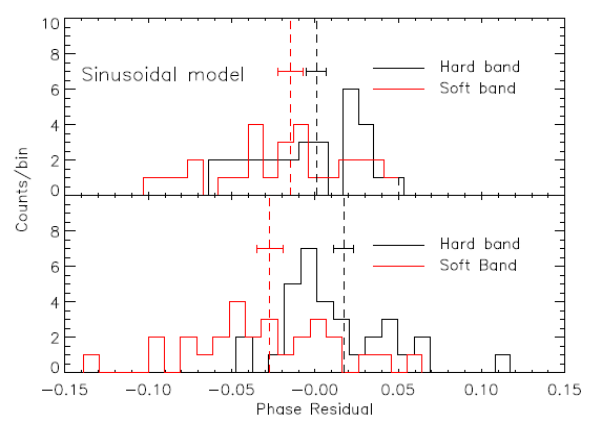
 | Figure: Superorbital phase residual distributions for soft (red) and hard (black) X-rays, with the smooth evolution trend removed. Data are divided into two epochs: MJD 53500 - 57000 (top) and MJD 57000 - 60300 (bottom). Mean values and 1σ uncertainties are indicated by dashed lines and horizontal bars. A significant phase shift of 0.044 ± 0.010 cycles between soft and hard X-ray bands is evident in the bottom plot
Professor Yi Chou has published a latest study that explores the evolution of "superorbital" light variations in the high-mass X-ray binary system LMC X-4 by analyzing 33 years of data from multiple space telescopes. LMC X-4, located in the Large Magellanic Cloud, is an accreting binary system consisting of a massive star and a compact neutron star. These two stars orbit each other every 1.4 days, while the system also exhibits a "superorbital period" of approximately 30.5 days. Astronomers point out that the core mechanism of this period lies in the existence of a prominently warped accretion disk around the neutron star. This warped disk undergoes a slow "precession," periodically obscuring the X-rays emitted by the neutron star during its rotation. Professor Chou's research confirms that despite the complexity of the disk structure and superorbital phase variations, the precession period of LMC X-4 is, on average, remarkably stable. Over the past thirty-plus years, the variation in the superorbital period has been only 0.55%, making it the most stable system of its kind currently known.
Intriguingly, the study found that after late 2014 (MJD ~ 57000), observation data revealed a distinct "phase shift" between the soft and hard X-ray bands. This phenomenon indicates that the geometric structure of the warped accretion disk underwent further deformation, transitioning from a relatively symmetric warped state to an asymmetric structure. This change in disk geometry caused a lag in the timing of when rays of different energies were obscured as they passed through the warped edges. This discovery coincided with a decline in the system's hard X-ray intensity, suggesting that the warped disk is now obscuring the central object in a new and more complex manner. These findings provide astronomers with an ideal laboratory for studying accretion disk behavior in extreme physical environments. By understanding how these warped disks precess, evolve, and shift over decades, researchers can further understand how matter flows under extreme gravity and radiation pressure. This marks an important step forward in the understanding of accretion disk dynamics within high-energy astrophysics. This research paper has been published in The Astrophysical Journal (
Chou 2026, ApJ, 1000, 23).
Show large images and more information |
